
Light Requirements
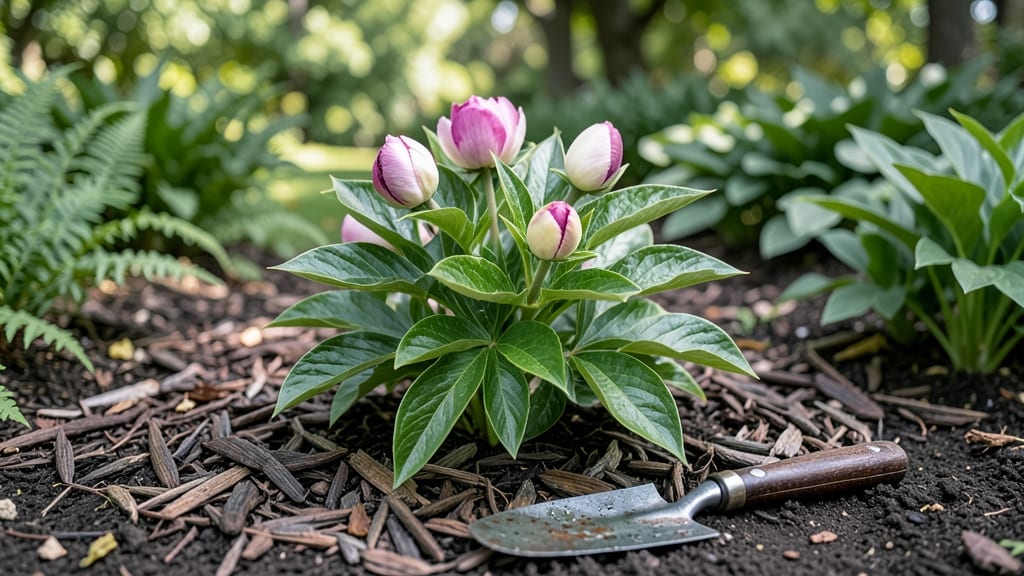
Peonies can grow in shade, but they thrive best in partial shade to full sun, with at least 4-6 hours of morning sunlight daily. Some varieties tolerate deeper shade, though blooms may be smaller or delayed.
While peonies can survive in shady spots, their growth and flowering depend heavily on light exposure. 🌿 Morning sunlight is especially valuable because it warms the plants gently, encouraging stronger stems and larger blooms.
In deeper shade, you might see fewer flowers or smaller blooms, but choosing the right variety can make a big difference. For example, Sarah Bernhardt peonies are known for their tolerance of partial shade, making them a great choice if your garden lacks direct sunlight.
If your garden has limited sunlight, focus on positioning peonies where they can still catch some indirect light throughout the day. Mulching around the base helps retain moisture, which is crucial in shady areas where soil stays damp longer.
With the right care and variety selection, you can still enjoy stunning peony blooms even in less sunny spots.
💡 In This Article
- Peony Light Requirements Explained
- Best Shade-Tolerant Peony Varieties for Low-Light Gardens
Peony light requirements explained
Peonies rely on photosynthesis to fuel their growth and flowering, and their light needs are directly tied to how efficiently they can convert sunlight into energy. These perennials have broad leaves that capture light, but they’re not as efficient in deep shade as sun-loving plants.
Morning sunlight (6:00 AM–10:00 AM) is especially critical because it provides gentle warmth that kickstarts photosynthesis without overheating the plants. In contrast, afternoon sun (after 2:00 PM) can stress peonies by causing rapid moisture loss through transpiration, which is why partial shade—especially afternoon shade—is ideal for many varieties.
The science behind this involves chlorophyll production. Peonies need at least 4-6 hours of direct sunlight daily to maintain healthy chlorophyll levels, which are essential for energy production. Without sufficient light, chlorophyll breaks down, leading to weaker stems and smaller blooms.
For example, a peony in full sun might produce blooms 3-4 inches wide, while one in deep shade could yield flowers only 1-2 inches wide.
The difference isn’t just size—shady peonies also produce fewer blooms and may struggle to establish strong root systems, which are vital for long-term health.
To assess your garden’s light conditions, observe how sunlight moves across the area throughout the day. Use a simple test: Place a white cloth in the spot where you’d like to plant peonies and check it every few hours.
If the cloth stays mostly dry by mid-afternoon, the area gets enough light. If it’s damp or shaded for most of the day, the spot is too shady.
Morning sun is your best ally, so prioritize locations where peonies can soak up those early rays while avoiding the harsh afternoon heat. This balance is key to maximizing bloom potential.
Another factor to consider is the angle of sunlight. Peonies benefit from light that filters through trees or shrubs, as this diffuses harsh rays while still providing energy. However, dense shade—like under a thick canopy—can stunt growth entirely.
If your garden has limited sunlight, focus on positioning peonies near the edge of shaded areas where they can still catch some indirect light. This approach mimics their natural habitat in woodland clearings, where they receive dappled sunlight rather than full shade.
For gardeners in regions with intense afternoon sun, strategic planting can make a big difference. Planting peonies on the north or east side of structures (like fences or walls) allows them to receive morning light while being shielded from the afternoon heat.
This technique is especially useful in hot climates where peonies might otherwise wilt. Even in partial shade, peonies can still produce stunning blooms—it’s all about working with the light you have and choosing the right variety for your conditions. 🌸
One common misconception is that all shade is equal. In reality, the quality of shade matters just as much as the quantity. Light shade (where sunlight filters through) is far more forgiving than dense, dark shade.
For instance, peonies under a 30-50% canopy (like a young tree or partial hedge) will perform better than those under a mature oak with a 90%+ canopy. The goal is to find that sweet spot where peonies get enough light to thrive without being overwhelmed by heat or drought.