
Size
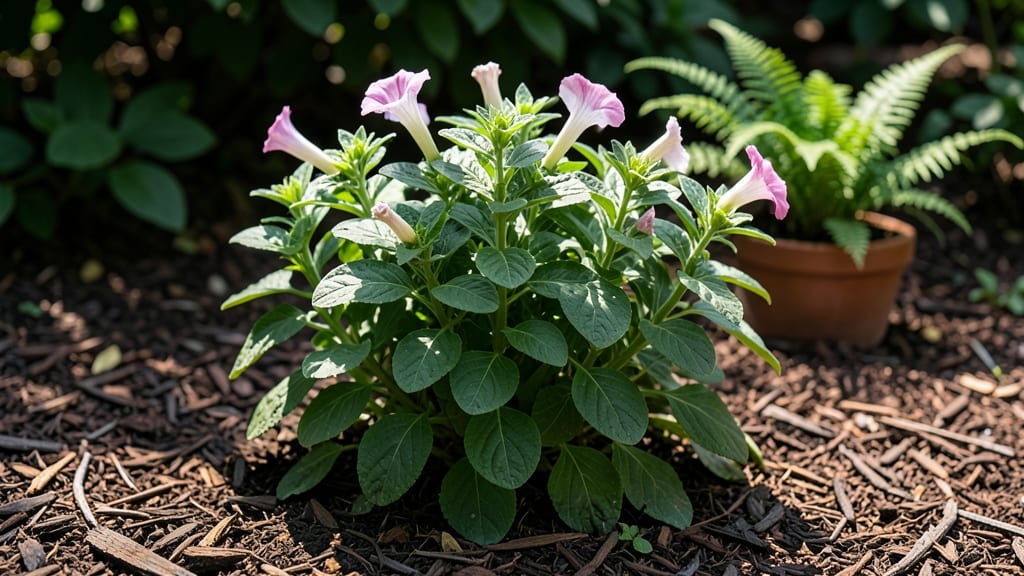
Four o'clock plants (Mirabilis jalapa) are surprisingly adaptable to lower light conditions, making them a great choice for shaded gardens. 🌿 However, their growth and blooming potential depend heavily on light intensity—direct sunlight boosts flower production and stem strength, while deep shade can lead to leggy plants with fewer blooms.
I've found that even in shady spots, these plants reward patience with late-afternoon blooms that open reliably around 4 PM, hence their name.
For optimal results in low-light areas, choose compact varieties like dwarf four o'clocks or Mirabilis longiflora, which handle shade better than standard types. Plant them near east-facing walls or under high-canopy trees where they'll catch morning sunlight.
Pair them with shade-loving companions like heucheras or hostas to create a thriving understory garden.
💡 In This Article
- How Light Affects Four O'Clock Flower Growth and Blooming
- Best Shade-Tolerant Four O'Clock Varieties for Low-Light Gardens
How light affects four o'clock flower growth and blooming
Four o'clock plants (Mirabilis jalapa) rely on photosynthesis to convert light into energy, but their efficiency drops significantly in deep shade.
These plants have a C4 photosynthetic pathway, which is more efficient in bright light, meaning they produce more energy—and thus more blooms—when exposed to 4-6 hours of direct sunlight daily.
In low-light conditions, chlorophyll production slows, leading to paler leaves and fewer flowers. 🌿 The pigments responsible for vibrant blooms (like anthocyanins) also require ample light to develop fully, which is why shade-grown plants often produce smaller, less colorful flowers.
Stem strength is another critical factor affected by light. Plants grown in full sun develop thicker, sturdier stems capable of supporting heavy blooms. In contrast, shade-grown stems become leggy and weak, often requiring staking to prevent flopping.
This is due to a process called etiolation, where plants stretch toward light sources, diverting energy from flower production to stem elongation. I've observed that shade-grown four o'clocks can grow up to 30% taller but with only 50-60% of the flower count compared to sun-exposed plants.
The timing of blooms is also influenced by light exposure. Four o'clocks are photoperiodic, meaning they bloom in response to daylight length. In full sun, they reliably open around 4 PM (hence the name), but in shade, this cycle can become erratic.
The flowers may open later or not at all if light levels drop below 2,000-3,000 foot-candles (a measure of light intensity). For reference, a typical living room has about 100-500 foot-candles, while full sun outdoors reaches 10,000+ foot-candles.
If you're growing four o'clocks in shade, focus on partial shade—areas that receive 3-4 hours of filtered light daily, such as under high-canopy trees or near east-facing walls. These conditions allow for moderate growth and occasional blooms, though not at peak capacity.
Mulching with organic matter (like compost) can also improve soil fertility, compensating slightly for reduced photosynthesis. 🌸
For gardeners in particularly dim environments, consider supplementing natural light with a grow light (12-14 hours/day) during the growing season. LED grow lights with a red-blue spectrum are most effective for promoting flowering in shade-loving plants. Place the light 12-18 inches above the plants to mimic natural sunlight intensity.
One surprising adaptation of four o'clocks is their ability to track sunlight (heliotropism) during early growth stages. Young plants will orient their leaves toward the sun, maximizing light absorption.
However, this behavior diminishes in mature plants, especially those grown in low-light conditions. This natural movement highlights their innate drive to seek light, even in challenging environments.